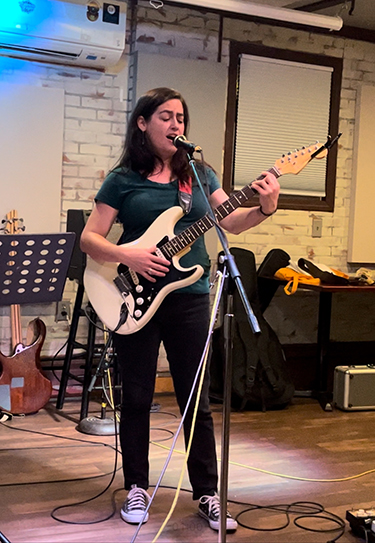
There is something terribly clarifying about existential moments like the one we’re living through. When all of life feels uncertain, we suddenly focus in a crystalline way about what really matters to us. It reminds me of Brené Brown saying, “The Universe comes down, puts her hands on your shoulders, and pulls you close and whispers in your ear, ‘I’m not fucking around.’” Bullshit falls away when a dear friend commits suicide or your brother suddenly dies or you realize that the worst of what you feared most about your country — that rampant intolerance, ignorance, and greed could prevail — has been affirmed.
This is why I’m singing, writing songs, and hanging with friends who want/need/demand an opportunity to belt their feelings out of their bodies and into the air. For the past week, I’ve embraced all opportunities to use my voice in the way I love best, through song. It won’t change the world, but it will change my mood, give me a sense of purpose, and possibly shift the mood of others in a positive way, and that can create a meaningful ripple effect. Each of us can only do what we can do right now: lean into what counts and “do the next right thing,” as the ever-wise historian/consoler/badass Heather Richardson Cox coached on Election Eve.
In my 20s and 30s, I played in a number of bands, and my favorite, most empowering feeling in the world was playing guitar and singing on stage. I left behind this practice for a bunch of years, for a bunch of reasons, abandoning the thing that brought me the most joy, and during the COVID pandemic — another terrifying, clarifying moment like this one — decided to pick up my axe again, raise my voice. It’s been humbling as hell to realize how hard it is to get the hand strength, mechanics, and callouses back, but I keep at it. Because I love it so much. Incremental improvements give me hope that I can front a band again one day.
On November 6, when the harrowing results were clear, I got over my insecurity about playing guitar in front of people (possibly because I was a teeny bit afraid the world might crumble any minute) and snagged a spot at an open mic to sing “Unfucktheworld” by Angel Olsen. I hadn’t brought my own guitar, my eyes were puffy from crying, and I wasn’t well-prepared. It was far from a perfect performance and I shook the whole time, but it felt amazing, and the small crowd watching was incredibly supportive. Doing the thing put wind in my sails.
The following night, I joined a friend onstage during his set to sing some backing vocals and play tambourine. The night after that, I heeded the call for “emergency karaoke” from my non-musician friends, proving that everyone is in need of song, and belted out “I’m Just a Girl” by No Doubt, the best protest song I could think of that would also be a banger at a bowling alley. The women in the audience roared. Saturday, I did a gang backing vocal recording at a new pal’s music studio, and once we got our parts down, hearing them come together in harmony and soar above us was magic.
It feels a little grandiose to say that art is an act of resistance, suggest that making music (or writing or painting or dancing or whatever it is that makes your heart delight) is a kind of activism, yet I believe it to be true regardless of whether we write or sing about politics. Writing and singing about love is just as powerful. Because that’s a refusal to deny ourselves the full expression of our lives and to harness what matters, to push against despair.
“People who subscribe to power over leadership often weaponize despair. They count on people giving up on themselves, their work, and each other…” wrote Brené Brown last week. “The research shows that hope is a powerful antidote to despair. What’s interesting, however, is that hope is not an emotion. Hope is a cognitive-behavioral process. It’s about having a goal, a pathway to achieve that goal, and a sense of agency or ‘I can do this.’”
I don’t profess to know much, but I do know that setting our sights on something, navigating toward it, and reaching that place is one of the most powerful things we can do with our lives. So, in the face of all that is uncertain, infuriating, and crazy-making, sing your songs — as loudly and clearly as you can muster. As the poet Mary Oliver said, “The most regretful people on earth are those who felt the call to creative work, who felt their creative power restive and uprising, and gave to it neither power nor time.”
Big thanks to new musician friend, Amy Wilkinson, for the pic!
 True Scrawl
Brilliant and spot on.